

“Behold, ye have sinned against the LORD: and be sure your sin will find you out.”
Number 32:23b
During the famous Valley Forge encampment of the Colonial army under George Washington, a westward campaign to settle the Ohio Valley by force would end far worse than ever imagined. The colonial army made it their ultimate goal to invade the British at Fort Detroit, thus securing the westward front, even as war sparked on the east coast. The success of the entire mission hinged on a 6 month window, and two gentle warnings from God. The tragic turn that was taken was found in the impatience of a general, the impotence of a newborn bureaucracy, and the ignorance of lost mankind to make peace apart from the Gospel.
The setting of this tragedy followed the meandering Tuscarawas River along a quiet, innocuous community called Gnadenhutten.
Amid the ghastly events following the Declaration of Independence, General Washington had devoted much thought to the possibility that the Western Department could go over to the offensive. The Western Department was one of seven divisions of the Continental Army devoted to securing what was then the western border of the United States, what was then known as ‘Ohio Country’. Ever since the first colonists had moved there, the temperaments of the Indian tribes were nothing but troublesome. They were easily bought off by the wealth of the British, and any alliance made with the chiefs was subject to change with the full moon. The American Indians were savage opportunists, hedonistic in mind, and heathen in their soul. Washington sought to sway them to the American cause with military power. The campaign that would peak (and dissolve) at Ft. Laurens in present day Bolivar, Ohio, would prove mans’ inability to leverage his fate with force. The sympathetic Indians would suffer right alongside the Americans, learning, “It is better to trust in the LORD than to put confidence in man.” Psalm 118:8
From a military stance, no one knew the predilections of the Indians more than George Morgan, the Indian agent of the Western Department at Fort Pitt (now Pittsburgh). He knew they were mercenary, able to be bought using hardly more than whiskey and rifles. But the British had more whiskey and rifles to barter with, and they were buying the allegiances of the tribes. Morgan, however, agreed with Washington: military force and political bargaining would be used to win over the unallied tribes. In his mind, an American power move westward was needed to gain an alliance with them as the Revolutionary War raged.
The Real American Heroes
What history fails to recognize was that an army had already won the western front. A Moravian missionary, David Zeisberger, preached the Gospel to the Woapanachke Indians (called ‘Delawares,’ from their word for: ‘I say’) and saw many of them converted to the Lord Jesus Christ. He established three towns– Schoenbrunn, Gnadenhutten, and Lichtenau– for the purpose of preaching and teaching the Bible. He learned, letterized, and published a spelling-book in the tongue of the Delaware (also called the Lenni-Lenape) so that he could teach them their own language. He was then able to translate the Scriptures from Luther’s German Bible and the King James Bible for them. The Delaware Nation’s sympathy to the Americans was all due to the work of this preaching pioneer.
You should understand that the Delaware was the most powerful of the Indian nations. At this time, Chief Netawatwes (Newcomer) had made peace with most of the tribes, and alliances with all others. This tribe was the key to the hearts of the Indians. Their passivity coupled with power made them a desirable ally. It is said that in his dying words on October 31, 1776, Netawatwes pleaded with the Delaware to follow the teachings of the Moravian pastors.
The Moravian method of evangelizing did not cumber to Americanize the Indians, but simply convert them, and allow God to change them. This is marvellously displayed in the civility and industry of Indians who believed the Gospel. The villages allowed the Christians a base from which to launch deeper and deeper into unconverted lands where they strove “to preach the gospel, not where Christ was named,” (Romans 15:20). Here, and here alone, American and Native lived in harmony.
But an ignorant and unbelieving army would be the Devil’s tool to mess up God’s perfect plan for Ohio Country.
A man named Lachlan McIntosh was hand-picked by George Washington to lead the offensive against Detroit. He was recommended by a man named Henry Laurens, who used his influence as a president of the Continental Congress to get him appointed. The pure politics here cannot be less obvert. The idea was subtly to give and get in exchange for fame and a name in the new government. (These are the same motivations powering the machine in Washington, D.C. today. There is nothing new under the sun.)
With everyone’s backs slapped and pockets padded, the time seemed ripe to move. On May 12, 1778, McIntosh was appointed to take the more than $900,000 that Congress allotted for the endeavour. On June 11, Congress resolved that “an expedition be immediately undertaken” to “reduce” the garrison at Detroit. The pressure was on to assemble, equip, and transport a company to Detroit. They intended to take a southerly route, avoiding the marshy shoreline of Lake Erie. For part of the journey, they would use boats to float both the Ohio and Tuscarawas Rivers to move the 3,000 men and supplies called for. But by July 12, the boats had barely been contracted out to be built. Summer days were passing quickly. Still, McIntosh thought he could make his move on Detroit before winter. In view of the desperate shortage of virtually everything needed for warfare, it was a dangerous gamble. Nonetheless, whatever the chances of taking Detroit, the desirability of doing so was hardly in doubt.
A Winter’s Foreboding
As urgent as it seemed strategically to start immediately, they should have never taken this journey. Two authoritative historians in the book Fort Laurens 1778-79, (Thomas Pieper and James Gidney) comment:
“In view of the bleak disaster which overtook the much shorter American penetration under McIntosh, the reader may be tempted to suppose that Morgan’s optimism was a kind of lunacy. But who is to say what would have happened if the expedition had set out in May rather than November?” (emphasis added)
Only 1,200 soldiers were able to be mustered. Their procrastinated progress was halted only a few days after it began. The winter season struck in Ohio country. Cold weather halted the American forces many miles short of their desired staging ground. The assault on Britain’s Ft. Detroit would never happen. The stunted army was stopped by the brutal, frigid Ohio winter.
The politicians whose dream this campaign was continued to defend its usefulness. The troops in the tents began to call the primitive campsite that would become Ft. Laurens, “Ft. Nonsense.” And they were not far from the truth. Ft. Laurens was both too far from Detroit to launch an offensive, and too far from the Moravian villages to be defensively helpful. Yet the pride of the budding American Republic would not listen to the gentle warning of cold and snow.
The Second Warning
After barely surviving the first winter of ’78-’79, the army gained the spring with ambitious hopes. However, on January 19, 1779, a Delaware scout brought word to David Zeisberger that the British were planning to besiege Ft. Laurens on March 2 of the year. Zeisberger, a pacifist, yet sympathetic to the suffering American army, immediately sent word to the shivering fort. The warning was discredited– coming from a missionary— and then ignored. Zeisberger himself trusted the truthfulness of the Delawares (many of whom he had personally led to Christ), and again sent a warning in early February. Delaware Chief John Killbuck corroborated the missionary’s warning on February 18, begging for the Americans to seek help. (Word would also be sent to Gen. Washington, but the news would not reach him until March 12.) The army belatedly sent a requisition for supplies to resist the upcoming attack, but once again, they were too late.
The British force arrived earlier than had been leaked, and attacked a logging detail outside the Fort on February 22. The army at Ft. Laurens was positively unprepared. Ft. Laurens became the scene of many horrors of war. Severe hunger, lack of morale and discipline, thwarted escapes, intercepted relief parties, and diseases of cooped-up human filth added to each gunshot, each scream, and each scalping as they fought to survive.
Miracle and Massacre
The British-allied Indians would have made short work of the fort. But wind of a wild looting raid by Kentucky militiamen against the Shawnee town of Chillicothe caused them to abandon the siege to help the neighboring tribe. The town was looted and burned to the ground though it had no military value in Ohio Country at all. The Indians rallied there and quickly rebuilt the town, and faced the white man’s imposition more angrily than before. The undisciplined, lustful militia who took it succeeded in little more than shaking a hornets’ nest.
But the distraction was a miracle to the suffering soldiers. Suddenly freed from the besieging forces, the army at Ft. Laurens retreated eastward. The failure that historians labeled, “the hobby horse of the Muskingum” was escaped and abandoned once and for ever on August 2, 1779.
The tale ends shortly, but not without incalculable repercussions. The idea to target Ft. Detroit would be quietly swept under the rug to save face for Morgan, McIntosh, and ultimately the future first President of the United States, George Washington. However embarrassing, it would be pleasant if we could end on that note. But the seeds of destruction, and spiritual sadness, had been planted.
“Be sure your sin will find you out.” Numbers 23:32
The action that had saved Ft. Laurens in the spring doomed the entire Western theater to unremitting horror during the last three years of the Revolutionary War. The attack on Chillicothe turned the Shawnees and indeed all the tribes (except a handful of Delawares) into implacable enemies of the Americans. At once, the Americans had demonstrated their inability to subdue the frontier, and instead inflamed it. Horror begat horror, savagery begat savagery.
The Sin Found the Nation
Through it all, the Moravians sought to remain neutral, moving into the heart of the Delaware Nation at Lichtenau to reach more of their own people for Christ. But, the policy of neutrality satisfied no one. Pro-war factions on the British and Indian side blamed the Moravians for constraining their efforts to mobilize the western tribes, while American settlers blamed the Moravians for sustaining cross-river raiding parties.
In August 1781, a large war party of western Indians in company with a British officer arrived at the Moravian towns, demanded that the Moravians to move to Sandusky and that the missionaries be turned over to the British. They claimed it was ‘for their safety,’ when in reality it was a move to conscript the Indians to the British side. They separated Zeisberger and his assistant, John Heckenwelder, from their flock, leaving them to survive on their own, while the missionaries were interrogated for war crimes.
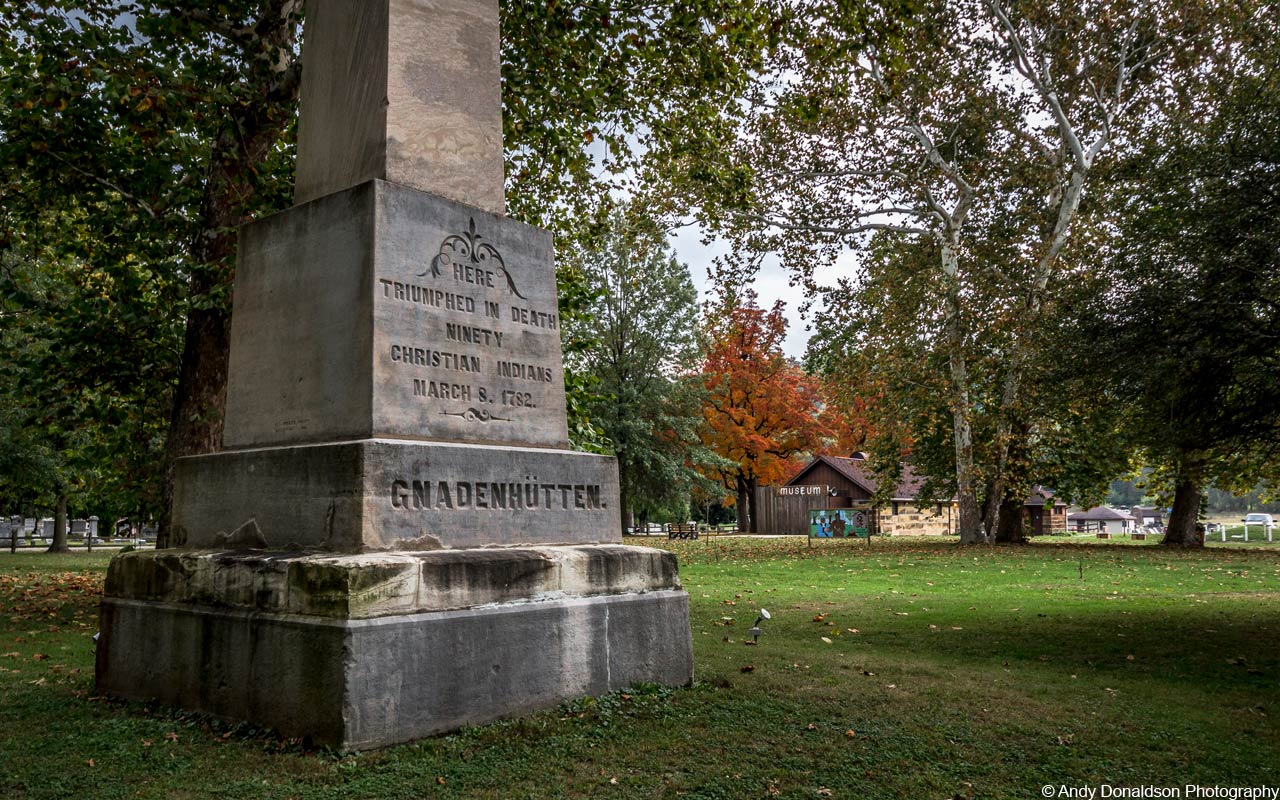
March of 1782. The winter took its toll on the displaced population. The starving Christian Indians at Sandusky decided to try and return to their villages, in hope that there would be some volunteer crops sprung up that they could nurture and live on for the next winter. While they were working their own fields near Gnadenhutten, a Pennsylvania militia mistook them for the feral Shawnee Indians with whom they were fighting. The unsaved colonists ignored the Bible-quoting, hymn-singing, and hospitality of the saved Indians, and, without due process or proof, sentenced them to death in mock justice for the Indian raids that the Revolution had sparked via Fort Laurens. In more ways than one, the Moravians reaped what they had not sown.
Ninety-six native converts were locked inside of two of their own homes, then brutally murdered, and the town burnt down around them. Not by the British, but by Americans. An event hidden in the shelves of American history and known as The Gnadenhutten Massacre. Thus was killed the first and last best hope for the Indian and American to live together. God’s way of peace was rejected for the American way.
The faithful Moravian Christians would pay the forfeit of their lives NOT to the British, but to their friends. The ghastliness of torture and death would have to be played out many more times before peace between Great Britain and the United States made it possible for settlers to inhabit one of the world’s most favored regions. But the greatest loss was the missed opportunity to win the indigenous tribes to Christ. The Moravian mission towns in Ohio would never sound out the Gospel again.
Lessons for Learning Americans
- First, “Pride goeth before destruction, and an haughty spirit before a fall.” The sainthood of the founding fathers of the United States is often presumed, but never proved. They were men who often acted in self-interest– not at all in the counsel of the Holy Spirit, nor according to the commission of Scripture. Had they known what God intended for ‘Ohio Country’, they would not have so ignominiously trampled on the sprouting mission work.
- Secondly, in an example of gross ignorance of military history, they underestimated the stopping power of winter. Few men, and fewer conquests have ever survived the cycling of the seasons. They were not prepared for nature, yet they thought they could produce a nation? Paul issued a taut warning for Timothy in his day: “Do thy diligence to come before winter.” (2 Timothy 4:21) To everything there is a season; once it is missed, better to wait than to act hastily. (Ecc. 3:1, Prov. 19:2) Discretion is the better part of valor.
- Thirdly, God had mercy on the foolhardy Americans. We fell under the grace given by the saying on the Cross, “Father, forgive them; for they know not what they do.” (Luke 23:34) and the sermon by Paul, “And the times of this ignorance God winked at;…” Those martyrs at Gnadenhutten represented the true, universal cost of faith in Jesus Christ. To us now, it is merely ‘freedom of speech, freedom of religion.’ But every born-again child of God knows we owe our liberty to believers of the Bible who did what was right regardless of which ‘side’ they were maligned to.
- Lastly, the Lord “…now commandeth all men everywhere to repent:” (Acts 17:30) The most important work to prolong the prosperity of any nation is to preach the gospel to every creature. We must pick up where they left off. No nation, left to itself, will procure the blessing of God. The job of this very abbreviated summary of these crucial years of American history is this: “Let him know, that he which converteth the sinner from the error of his way, shall save a soul from death, and shall hide a multitude of sins.” (James 5:20) Like the Moravians of old, win them before it is too late.
One day, God Himself will set the record straight. This essay– and my opinion– of history may not sit well with you, but I rest my case before a higher court: “Because he hath appointed a day, in the which he will judge the world in righteousness by that man whom he hath ordained; whereof he hath given assurance unto all men, in that he hath raised him from the dead.” (Acts 17:31)
Sources:
- “Moravians in the Middle: The Gnadenhutten Massacre” – Journal of the American Revolution, February 6, 2018 by Eric Sterner
- The Diary of David Zeisberger, 1885
- Fort Laurens, 1778-1779 : the Revolutionary War in Ohio, 1976 by Thomas Pieper and James Gidney
- The Pioneers: The Heroic Story of the Settlers Who Brought the American Ideal West, May 7, 2019 by David McCullough
- David Zeisberger’s History of the Northern American Indians, 1910 edited by A.B. Hulbert and W.N. Schwarze, Ohio State Archaeological and Historical Society






Discover more from Spiritual Reload
Subscribe to get the latest posts sent to your email.

Ah. What a good good Reload.Sara BurrisOn Aug 27, 2026,
LikeLiked by 1 person
Thanks, Sara. A little too intense for the kids, I suppose.
LikeLike
Yep. Been there. Really sobering stuff. Thanks, brother.
LikeLiked by 1 person
Gnadenhutten is a gem of real Christian history. You should visit Schoenbrunn too if you get a chance.
LikeLiked by 1 person