

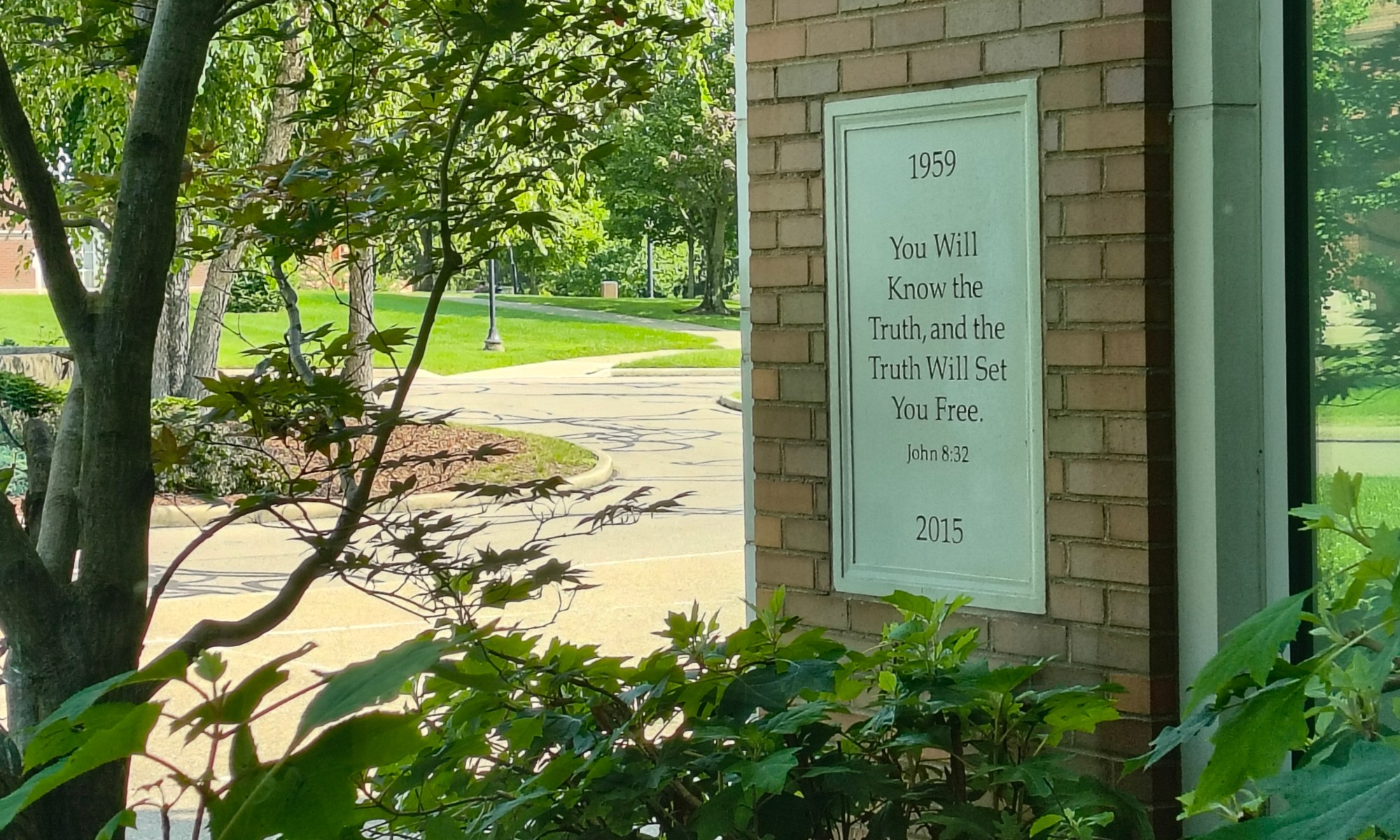
“And further, by these, my son, be admonished: of making many books there is no end; and much study is a weariness of the flesh.”
Ecclesiastes 12:12
“Till I come, give attendance to reading, to exhortation, to doctrine.”
1 Timothy 4:13
(This photo was taken from the Muskingum College Library. Surrounded by books– no Truth to be found)
The Bible recommends men to read in both Old and New Testaments. Alongside the recommendation for daily Bible reading(DBR) comes an intimidating reality: there are a LOT of other books out there. Man’s primary calling as a Creation of God is to live for God’s pleasure. With the ease with which text may be spouted out today, how can you be sure that what you read is worth reading BEFORE you waste your time with it?
This will be a long write up. You can skip right to the DO’s and DON’T’s. My aim is to enable you with time well spent here to redeem your time out there using some tips from this article.
Background Thought of Scriptural Writings
Most early writings from believers in the first centuries after Christ were lost due to Roman Catholicism. Doctrine and instruction were passed down, not via papal bull, but by word of mouth. Whole books of the Bible, sermons, and other like correspondence were memorized and messengers rehearsed these in front of a congreThogation, who likewise hung on every word. Since communication from another church, another pastor, or even an apostle was scarce, they memorized every word. The daily devotion of first-century Christians came from what they kept close in their hearts and minds.
The early writings were works of necessity and efficiency. Handwriting was tedious; ink and paper were precious. Names and words were abbreviated, and every margin was used up to fit good words.
Gutenberg’s moveable-type printing press has been named one of the 12 major markers of world history1. With this invention came the end of the Dark Ages. Knowledge spread in book crammed with small-point font. Though pen and ink remained the primary creative medium, the press was able to reproduce words to the masses with much less effort. Transcribed speeches, including sermons and lectures were preserved on paper with wide and long paragraphs of trailing thought– not for the faint of heart!
During the World Wars, the printed word went wild. Conscripted production of ink and paper swelled the market. Offices of every kind became printers. Competition for readers begat a sales-oriented authorship, instead of vetting an author’s true worth. Ephemera, magazines and pulp fiction flooded the newsstands. The printed word became the core of a rapidly growing snowball. As it raced along it swallowed the television, the personal computer, and the entertainment industry. This influence is too large to ignore, and ever harder to avoid. The world is being overrun with words.
Most readers sank into a near-bottomless pit of comics and romance novels, never to resurface. The literacy rate and surplus of material made the statistics look great. The reality for the individual, however, proved to be much less flattering. We were obese; stuffed full, and had no appetite for any meat, only a little room left for dessert.
We have much to choose from, and less patience for the drawn-out discussion. Now, it is rare to hold an attention longer than 10 minutes. Studying is out of the question. The sales of audiobooks were more than double the sales of print books in 2023. The gargantuan rate of video uploads to the internet reports volumes in excess of 82 years per day. These two distinct but parallel fields (audio/visual) show that your time is more challenged than ever.
The believer is charged with “Not forsaking the assembling of ourselves together, as the manner of some is; but exhorting one another: and so much the more, as ye see the day approaching.” (Hebrews 10:25) A healthy, Biblical, local church maintains a steady first-day worship and a consistent midweek prayer meeting. The church has kept a good pace. Though some may point to a lax meeting schedule contributing to the decline of the average Christian, in my experience, the church is not the culprit. The world has hijacked the tools of our trade, and is using them mightily against us. There is more attacking us in a given week now than would be possible in a calendar year in the pre-internet world.
Toss a struggling believer a couple sermons a week; is that enough to keep us living for Jesus in our last days?
I believe not.
Enter the daily devotional. Let’s call it a snack food. Concerning the necessity of Itself, the Bible says, “Man shall not live by bread alone, but by every word of God.” (Luke 4:4b) What daily Bible reading serves is a staple diet. What Sunday gives is a chef-curated feast. But a quick pick-me-up is needed sometimes, and thankfully God’s word is able to be milled for this exhausting time in history to help us finish our race. This relatively new recipe for getting spiritual food is designed to be portable, provocative, motivating, and consistent. Let’s bite into each one.
Spiritual Supplements
A daily devotional is a form of spiritual snack food. It can give you extra calories to punch through a day, but it is not a healthy long-term diet. The idea is to be convenient enough for you to keep your mind on track as your life hurls through a busy day. It’s the afternoon boost to beat the drowsiness.
- Portable. A daily devo is usually under a page long. If you’re on the internet, that’s one screen full, and no more. The whole thought is kept to one page to allow you to get it at a glance, and lower the risk of losing focus. Due to their small size, a whole month can be printed into a booklet using just 8 half-sheets of paper. We’ll talk about the month in a minute.
- Provoking. Novelty has become necessary to duty. A paragraph or two is not enough to reframe a doctrine, but it is enough to interject a factoid not usually considered, or alter someone’s perception of it. Sometimes sermons are given in outline form only, letting the reader fill in the blanks. A daily devo lets you read into it, as much as you read out of it.
- Motivating. Real life application is stuffed into each reading, whether it’s a prayer to pray at the end or an illustration from Christian history. Devos have a hyper-emphasis on do over know. They encourage the decision to act, even if the ability to act is not possible. Anything you learn is put to work instantly.
- Consistent. Printed daily devos usually come out in week- or month-long formats. These are typically put together by a pastoral oversight intended to help you think as a “Christian” should. By “Christian,” I mean, whatever denomination or philosophy the authors deem credible. No publication is without the bias of its authors. There will not be a one-size fits all devotional. For the more you read a particular bias, the more that viewpoint becomes your own. Consistency is what frames that window of thought in your mind.
Got To Be More To It Than That
Jerry Jenkins offers a complete course on devotional writing. Jenkins was best known to millennials like me for his fictional “Left Behind” series. His pointers for what makes a good devotional are an inviting approach, direct language, styling for your audience, and draw the lesson from scripture. Of course, what he calls scripture is left to the writer’s discretion; for although a “pure heart,” “focused mind,” and “a burning desire,” are essential to be a good devotionalist, the Bible is not as indispensible: “When you settle on a passage of Scripture(sic) as your anchor text, read it in different translations.”2
Doubtless he has coached many thousands more than I have. For the approach he has and the pattern he sets are obvious in the hundreds of so-called Christian publishing houses, physical and online.
IF what he has is ‘good enough,’ you would not be halfway through this article on Spiritual Reload. You are wise enough to know that there’s got to be more to it than that.
You Don’t Have Time To Waste
As we alluded to at the beginning- the amount of time you share with your ancestors in the faith may be the same, but the draws on that finite time are multiplying with every passing day. You don’t have extra moments to waste on just any kind of input into your life. If you watch a movie and think, ‘That was a waste of time,’ congratulations! You have learned, but you cannot unsee what you saw, nor can you reclaim the time that’s lost.
There is a lot of good out there. Tremendous help can be found in dull cloth-covered books in church basements across the nation. Bible-believers have never made the best-seller list, but they have not failed to write. My fear is that I will absorb what’s around me, only to discover too late that my spiritual diet left me deficient. So I read every book as though it was the last time I’ll ever be able to pick it up.
I have subscriptions on WordPress, on Substack, and some via email. I receive a monthly bulletin, grab a weekly paper, and my church gives out a daily devo booklet every other month. Can I read them all? Perhaps the better question is SHOULD I read them all? As spiritual snack food, what may come in handy in a pinch might ruin my appetite for better things.
Above all else; what would be most pleasing to the Lord in my reading habits? What can the Bible teach us about other reading?
How To Choose A Devotional That You Will Actually Read
Remember two things as you go into this from our opening verses. Number one: you should give some attention to reading. Number two: there is so much to read out there that it will wear you out. It wore Solomon out!
A higher risk than reading a less-than-ideal devotional is that we subscribe to too much, are offered too much, and we duck out of any reading at all. This is what happened to me, and I hope I can save it from happening to you.
The Don’ts
Don’t pick a devotional that takes the place of your daily Bible reading.
Get this first: the BIBLE is the reason you have a spiritual life at all! “The words that I speak unto you, they are spirit, and they are life.” (John 6:63b) The only advantage offered from reading what a man wrote versus what God wrote is to gain understanding from someone who’s read the BIBLE more and walked with God farther than you. When Philip asked the Ethiopian Eunuch, “Understandest thou what thou readest?” he mourned, “How can I [understand], except some man should guide me?” (Acts 8:31)
So, read the BIBLE first. Read the devotional second. Next thing…
Don’t pick a daily devo that is longer than your daily Bible reading.
Same reasoning as above. The Bible is the real meal. If you are not balanced here, it won’t matter what else you do, it won’t build your faith as it should.
Don’t pick a daily devo that gives you your daily reading assignment.
This may only irk me, but for good reason. If DBR reigns supreme, it will flourish the symbiosis between you and the Spirit of God. Much as we wouldn’t let a pope or priest intervene in our relationship to God, let us also not elevate an author to that post, either. Limiting that time, reading in ‘selections’, or over-committing will dull the mind. Wonders can be done through a simple commitment to x chapters a day, beginning to end, every day.
Don’t pick a daily devo that wanders translations.
This will save you time. If your shopping for an item at a box store in North America, you may be tempted to go on the cheap. But see this choice as something that must last you a lifetime– no hesitation there: top shelf only. No off-brands. Any thug can spin the original and undersell it. Be sure your sources give, “honour to whom honour.” (Romans 13:7) There is a reason the best is still around. Don’t settle for less: take the King James Bible.
If you want to read a book about what the Bible doesn’t say, get any English version published since 1881. If you want to go back to the Dark Ages, dive into that Greek or Latin stuff. If you want to pretend to be a Jew under the law, crunch that vowel-less Torah right to left. If you want what God said, how He meant it, exactly the way He expects you to take it, get just ONE BOOK. The Authorized Version. 1611. You can get in Gothic or Roman font. You can have it with marginal notes or none. But the Scripture has been given by inspiration to us in English–and if you have read this post thus far– you speak English!
In summary of the DON’TS: Be your own editor. Redact more than you add. Once you have cleared the desk of a bunch of junk, you can get a read-worthy stack going.
The Dos
Pick a devotional that will fill (not fit) your schedule
Alright, so you’re reading your Bible first. Good, the closer to the morning the better. Now, when are you most often in a slog in your day? When do the hottest temptations show up? Aha, that’s when you could use a few extra spiritual calories to muscle through.
Avoid trying to cram it in immediately after your daily Bible reading. You’ll be stuffed, and it won’t benefit you later.
Plan for that spiritual shot in the arm at that later point in your day. You must plan for it, or else you won’t do it at all. Fill the time, don’t fit something if you have time. You won’t.
Pick a devotional from your Pastor
If your church is blessed to have a pastor who preaches and teaches multiple times a week from fresh passages of Scripture, you had better thank God! Many pastors are not capable of that, because they haven’t been called to preach. They just ‘do ministry’ for a living.
In seriousness, if you have a Sunday School class, a morning and an evening sermon, and a midweek Bible study, you OUGHT to be getting in on all of that BEFORE you go picking up any cheap devotional! Regular church attendance under a Bible-believing pastor may well eliminate the need for a devotional booklet altogether.
But if you are getting all you can out of church, and still need more– see what your pastor has to offer. There is a good chance he can 1) recommend a good source, or 2) provide you with one himself. There are a couple good reasons for this.
An author conveys part of themselves into everything they write. As innocent as that may sound, (especially in the case of a three paragraph devotional) in the realm of practical spiritual growth, no one invests more in you than your local pastor. It’s easy to see the flaws in his theology after he’s done all the work to make doctrine palatable for you. Notwithstanding, if he believes the Bible and loves the Lord, and is laboring for you, don’t start a beef with him with a half-baked idea from a cheap paperback.
I say this because many publishers are so bent on production and ‘content‘ that they could care less if you baptize babies, sing contemporary songs, or are missions-minded or not. But your pastor has worked hard to teach you rightly on each one of those. How inordinate to let your snack food shape your convictions!
Your pastor may have studies that he will never preach that he could email you. He may have notes from his Bible he could text you. Why, he may even have a blog that you could subscribe to! Give him the first shot, at least.
Keep a Bible-reading journal to rehearse what you read
By taking a few simple notes along with your DBR, you can make a devotional out of it. It may come out as a verse to memorize, or a Proverb I put to practice. A song may be queued from the Psalms. This is the ‘pack a lunch’ method of getting spiritual pick up.
Pick a paper devotional over an electronic one where possible
Keep some tangible reminders of spiritual priorities. Carry your Bible in a book. Wear a wedding band on your hand. Give your offering in $20 bills in an envelope on Sunday. And if you need a devotional help in your day, stuff it in your back pocket or lunch box or desk drawer.
For Distraction’s Sake
We have leveraged too much control to unseen forces when we rely on electronics. There is too much that can go wrong. There is a great probability of distraction with anything accessed online. How many browser tabs do you have open right now? By all means, go check, but you won’t remember why we even brought it up. And if you come back here, count the time lost in that one simple diversion. You can’t afford that.
We get the Baptist Bread at our church. It is a squat booklet that has 60 days of devos packed into it. Our pastor has submitted to it in the past, and all the contributors are pastors of local likeminded churches, or at least preachers of the Gospel. It fits into a pocket neatly, and is discreet.
We also give our church a booklet sourced from Spiritual Reload that we call the Field Guide. It is for men only, and we make select Reloads available physically to avoid the web trap. Knowing how fellas can be a little rough on stuff, we make it on Rite in the Rain waterproof paper. The stuff holds up good, and looks sturdy. Eight to twelve pages hold 3-4 articles a month that have enough to do in them that makes it worth keeping around for a few weeks. Its like a personal, mental checklist from what you read here.
Obviously, Spiritual Reload publishes articles online. I prefer getting articles emailed to me, that helps me stay more focused than browsing the blogosphere. If you’d like to get them emailed also, just go here, and type in your address.
For Disposal- Read it and move on
One of the reasons I like the physical copy idea is the satisfaction of throwing, or putting it away, once for all. Hear me out.
When you get an email, or read something on your phone it requires more mental foresight to deal with it than in print. For example, you are getting a subscription right now in your inbox that you haven’t opened let alone read in months. Why? The guilt of ‘unsubscribing’ is basically holding you hostage. The anxiety of ‘I may want that someday’ fills up your mind with hollow angst.
A second example, for things like devotions that you look forward to reading every day. One gave you a new cross reference for your Bible– you kept it. One brought tears to your eyes through a story that hit close to home– you kept it. Another challenged the way you perceived life– you kept it.
Here’s the problem with that:
You will never write that reference in your Bible margin. The next time you read that story it will not bring a tear, but a memory of a tear. That perception-altering thought? It will not bring about a new change when (or if) you ever look at it again. Cherish the memory, but quit trying to relive the moment.
For some reason, we allow electronically stored stuff to clutter and pile up. Endlessly so. We wouldn’t tolerate that kind of a mess on our dining room table, would we?
Declutter your life. I don’t keep old newspapers- I start my fireplace with them. Don’t keep old devotionals. Rarely will they ever serve you that well again.
And lastly, deleting or trashing that devotional at the end of the month helps you must realize that this will be the last time you’ll ever read it. That ought to make it stick better.
“I had many things to write…”
As the Church age comes to a close, spiritual writing (starting with the Bible) will be less and less heeded. 3 John 9 and 13 show failing respect for spiritual words, and perhaps John’s discouragement. “I wrote unto the church: but Diotrephes… receiveth us not.”
Yet there was a need for his pen. For as John stood before the throne of God he heard: “Write: for these words are true and faithful.” (Revelation 21:5)
We will see history come full circle, and all that will survive are the Words of God. The daily devotion of first-century Christians came from what they kept close in their hearts and minds- my prayer is that whatever supplement you choose, it will pull you toward that main goal.
“And when this epistle is read among you, cause that it be read also in the church of the Laodiceans; and that ye likewise read the epistle from Laodicea.”
Colossians 4:16





- Donovan, Brian The History of the World in 12 Steps, The Bible Believer’s Bulletin, Vol. 50 No. 5, May 2026 ↩︎
- Jenkins, Jerry How to Write a Devotional: The Ultimate Guide December 2025 ↩︎
Discover more from Spiritual Reload
Subscribe to get the latest posts sent to your email.
