


“So Ebed-melech took the men with him, and went into the house of the king under the treasury, and took thence old cast clouts and old rotten rags, and let them down by cords into the dungeon to Jeremiah.”
Jeremiah 38:11
Last year, we presented 11 Ways to Reuse Old Bibles. That guide, along with this one, will present clear-conscience alternatives to just allowing Bibles and tracts to decay in your garage or attic. There are lots of links to follow, so read and bookmark for later use!
If you’re a Bible-believing Christian, tracts are indispensable to your personal every-day-carry.
Dr. Sam Gipp taught me at a very young age to never leave my house without “TNT:” “Tracts, New Testament.” Tracts have been around since before the printing press as a way of spreading the good news of the Gospel. They reserve a place of distinguishment in every Christian’s armory. But when this vital part of your EDC gets a little wear and tear, you may consider one of these suggestions before putting them in the circular file.
What is a Tract?
According to one tract publisher, “Gospel tracts contain the Word of God, and are like living seed. When planted in a person’s heart, God can use that seed to create new life—eternal life.” (Moments With The Book) All of the Bible is for us, but not all of it is to us. A tract gets to the point to show the nitty gritty of the Gospel to an unbeliever. Tracts are usually just a few pages long, take mere moments to read and are easy to understand.
Tracts are much more economical to produce than Bibles or New Testaments. They can cost as little as $0.07 for a 4-panel tract, to $.0.50 for a full-color comic. Though they are cheap, they are not free, and they contain the most valuable notes on eternity that you will ever read.
Many publishers have surprising background stories and colorful founders. Jack Chick, of Chick Publications, and Helen Cadbury of the Pocket Testament League are two spectacular opposites who both devoted their talents and resources to the Gospel Tract. Trusts have been established to make sure that tracts are printed as a legacy of a believer’s obedience to the Great Commission.
Although there have been many guides on both how and why to use Gospel tracts, there is an unfortunate and inevitable end of these booklets to consider. When given out evangelistically, you can expect to see them torn up, thrown on the ground, urinated on, or graffiti’ed. But too many other tracts will meet their untimely end on the floorboard of a vehicle, lost in a purse pocket, or sun-faded on a church’s tract rack. We are thankful when they can be expended in a good cause- but we ought to be a little more convicted with letting them go to waste because they are inexpensive.
A Tattered Lifeline
Jeremiah languished at the bottom of the prison under the king’s palace. He had been dropped into the raw sewage and left to die. He had only one advocate who remembered him, Ebed-melech, ‘the servant of the king’. And though Ebed-melech got permission to pull him out, he couldn’t find anything that would work to lift him out but some scraps of cloth. Jeremiah thanked God that they didn’t throw those scraps out.
We’ve put together some useful ideas to keep even the “old rotten rags” from going to waste. When you find that dog-eared and crinkled Gospel tract in your glovebox, consider one of these methods to keep it out of the garbage, and get it into someone’s hands with dignity due the Message.
1. Press them as a bookmark at the library
Are you old enough to remember scavenging the curly crinkled autumn leaves for a school project? You would find the thickest, heaviest encyclopedia to open somewhere between ‘Croatia’ and ‘Dinosaur’ and slide your samples for safekeeping. Some of them are probably still there!
Most communities in America are blessed (?) with a public library system. Colleges and universities may have collections also, depending on the wishes of the benefactor. Sadly, most quality books have been moved to the most obscure storage areas of today’s public library. They have been evicted to allow for licentious, obscene, provocative, or cultish novellas. Case upon case of artificial picture books litter the foyer of such places. These stories, roughly called ‘literature’- are good for nothing more than to light a backyard grill.
But that wrinkled up tract that has been in your pocket all day has redeeming value. All it needs is to find a new home inside of that pointless fiction on the featured book rack at your local library. The book will press out the wrinkles, and perhaps the little paper will give some truth in an unexpected place.
2. Leave them at a worksite
There is a time and place for a sharply pressed shirt and tie; and there is a time and place for a pocket-tee shirt. One shows professionalism; the other gets to work.
When you are going door-to-door and meeting people, have a brand new tract to go with your first impression. But there are a multitude of places to stash a tract in ‘work clothes’ to get the job done. See Chick’s ideas from his comic book tract, “Who, Me?”
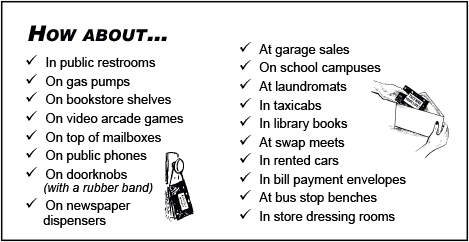
On this note, you shouldn’t refrain from leaving a tract because the tract is too new. Always give the best you have. But if all you have is your second-string, play the second-string.
3. Clip them for sermon notes
This has proven to be both a time-saver, and a memory-jogger. Tracts often have well-written short stories with pointed illustrations. That is often what gives tracts a punch that makes people either love ’em or hate ’em.
Tracts provoke colorful encounters with people that can edify the Sunday morning-only Christian. I have used the tract itself as a page for my sermon notes to help me not only tell a story but also illustrate its affect on a live subject. Sometimes its the visceral tears, folds, and stains that paint the most vivid recollections.

Some tracts have an eye-catching illustration that has inspired a chalk-talk message. “Tell It Like It Is” from the Bible Believer’s Bookstore and “God says, Please Do Not Go To Hell” provide good sample material for this.
4. Use as street-preaching outlines
An open-air preacher knows the complications of preaching loudly and simply enough for the message to be taken in. A street preacher may only have 27 seconds (the length of a particular traffic light in my area) or he may have 2 hours. The short and long problem when you are breathing from the diaphragm and speaking from your chest is remembering what you need to say.
Enter: that tract stuck into the cover of your New Testament for a week too long. There is enough there to quote from directly; just read the tract loudly and slowly. There is also enough there to pollinate your thoughts if you should have 2 hours uninterrupted to preach by the wayside. “The Ten Commandments” and “Hear Ye Him!” are two Fellowship Tract League tracts I have used this way when learning to preach on the street in Pensacola, FL.
5. Use as memory flashcards
An excellent use that I have found that provides a context for verses to bring them to mind when you need them. Whether it’s the ‘Romans Road,‘ or the ‘Isaiah Interstate‘ (names given to salvation scriptures within a single book of the Bible), a tract can lay the mental groundwork to discuss many life topics from the Scriptures.
In the case of the wore out tract- single tracts can be cut into even smaller sections to make a verse card to carry with you. For instance, you could take the 5 sections of the Romans Road (Romans 3:10 and 23, 5:12, 6:23, 5:8, and 10:9-13) and cut out each one verse to commit to memory while you are at work Monday through Friday.
“All This I Did For Thee” has a tremendous statement and striking image on the cover, and the tract itself is entirely Scripture with headings.
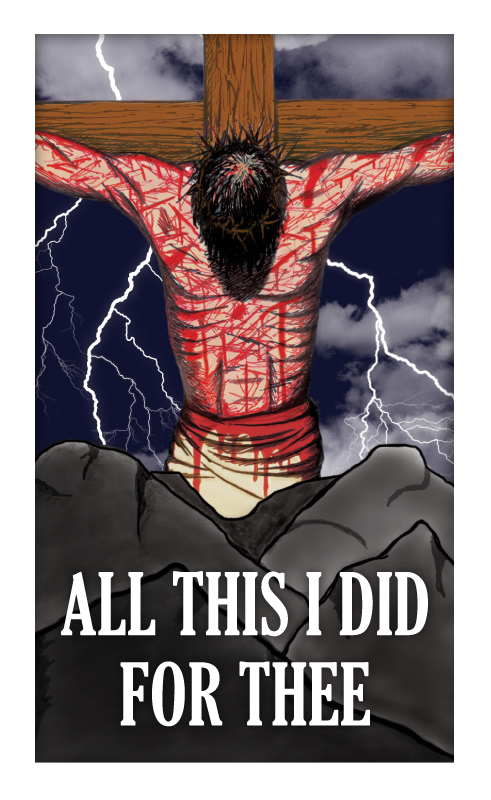
- “I CAME… because of your sin.”
- “I DIED… to pay for your sin.”
- “I AROSE… to keep you saved eternally.”
- “YOU MUST REPENT… admitting you are guilty.”
- “YOU MUST TRUST… putting your complete faith in Jesus Christ to save you.”
This groups the verses for easy remembrance and recollection. And carrying a paper with you all day to refer to while working, commuting, waiting, or taking a break will definitely save wear and tear on your Bible.
6. Craft them
This idea always appealed to me. Some tracts have a peculiar picture such that, even if the booklet is never opened, the picture will stick. Use that picture! (Provided it is still intact after the tract has bounced around the bottom of your purse…)
- Make tags for gifts out of them.
- Hang as a mini poster on a community bulletin board.
- Offer the black and white ones as coloring pages during church for little ones (or at a retirement home)
- Use as a puzzle for youngsters to help them put the Gospel verses in order. Cut the pamphlet into shapes, then have them reassemble the picture side. Then flip the completed picture over, and teach the verses/concepts/story in its correct order.
Better is the end than the beginning
There are countless ways to creatively give out a Gospel tract. I hope you will visit some of the pages referenced in this Reload to explore their ideas and read some testimonies. Thank God for the availability, expendability, and reliability of tract-writers and printers to fuel the Great Commission.
Let’s be wise with this resource: always have a fresh stack, and use them daily. And when the kids get ahold of them or you get down to the bottom of the barrel I hope you’ll make use of those “rags” one last time.
Discover more from Spiritual Reload
Subscribe to get the latest posts sent to your email.

like message on beat up tracts and bibles
LikeLiked by 1 person
interesting.on worn tracts and worn out bibles
Some I have thought of..great article
Thank you..
LikeLiked by 1 person